A while back I sat across from a business owner who was convinced that touching his prices would empty his client list overnight. He wasn’t reckless. He was close to his numbers, careful with his people, and genuinely worried. That worry is the reason his money had been sitting still for years.
I’ve watched this pattern hold across service business after service business. The profit an owner wants is already inside the building. The work isn’t about courage. The work is diagnostic.
The Fear That Keeps Money on the Table
Most owners treat price like a load-bearing wall. Move it wrong and the whole structure comes down. So they either leave it alone or apply a timid increase across everything at once, which spreads the risk into the fragile corners of the business where customers actually walk away.
That instinct is understandable, and it’s also where the trouble starts. A felt risk and a measured risk are two different things. When you separate them, the measured number usually tells a calmer story than the fear does.
The real question isn’t whether to raise prices. It’s which single price the market already rewards and barely notices.
What I Actually Looked For
I didn’t scan his whole menu for things to bump. I looked for one offering that the market paid for happily but that he had priced from habit rather than from worth. Every established business has at least one. It’s the service clients keep coming back for, the one they’d renew without blinking.
That habit gap is common because pricing rarely gets examined on purpose. As one pricing analysis put it plainly, pricing decisions are often ad hoc, driven by sales pressure instead of study. Prices get set once and then quietly outlive the value they were meant to reflect.
So we found his one service. High value. Steady demand. Priced years ago and never revisited.
The Small Number That Wasn’t Small
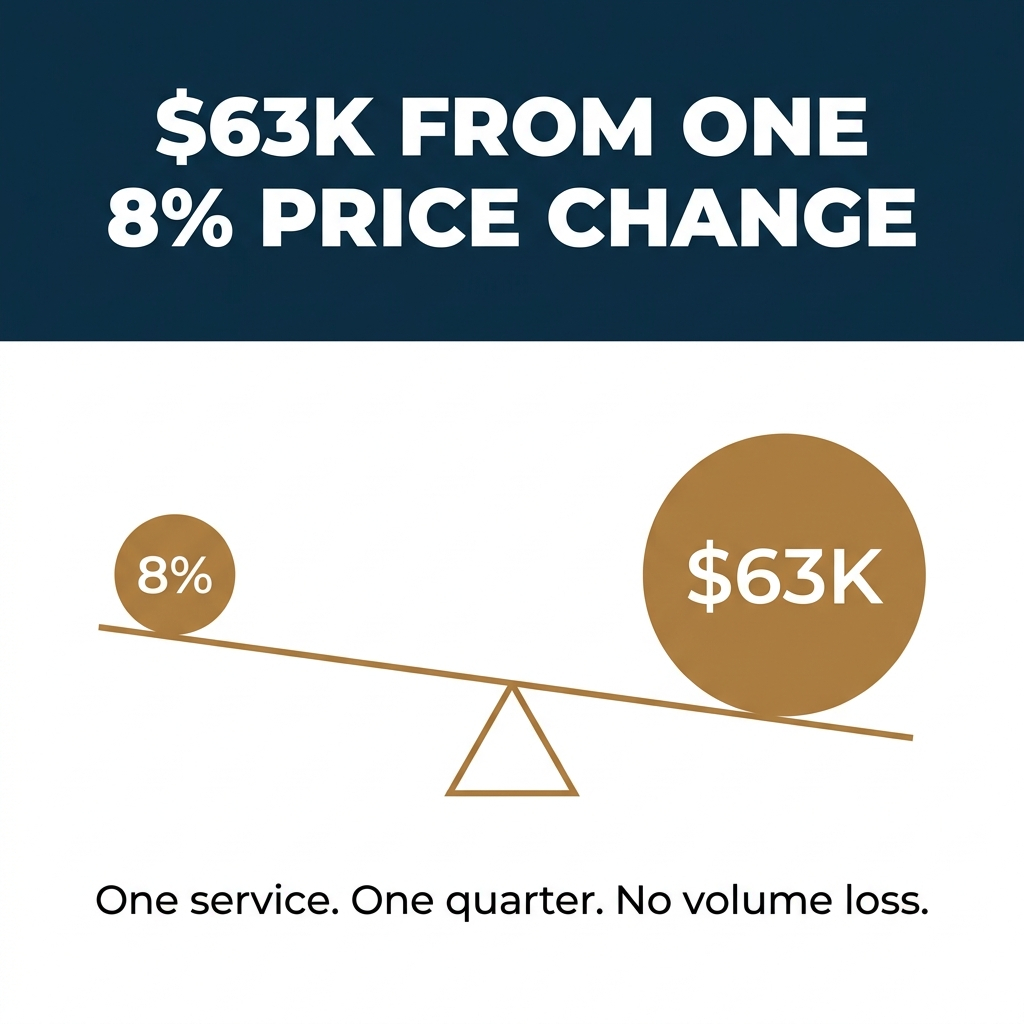
We raised that single price by 8 percent. That’s it. One line item, one adjustment.
Before pulling the lever, I reverse-engineered the move. A small percentage on price behaves very differently than a small percentage on cost or volume, because almost all of it drops straight to profit. Harvard Business Review studied 2,463 companies and found that a 1 percent price improvement lifted operating profit by 11.1 percent, while the same gain in volume moved profit only 3.3 percent.
Inside one quarter, that 8 percent generated an additional $63,000 in annual profit. Volume didn’t drop. The clients who valued the service barely registered the change.
Why Nobody Left
The comforting story owners tell themselves is that every customer is price-sensitive. The evidence says something narrower. Sensitivity depends heavily on who’s buying and what they’re buying. Price Intelligently analysis found elasticity differences of up to 3x between customer types, with high-value buyers registering far less.
When a service genuinely delivers, the gap between what customers tolerate and what the owner assumes they tolerate is usually wide. He assumed the edge was right at the current price. It was well above it, and had been for a long time.
💡 Design the change so you can watch it. One price, one service, tracked for a quarter, reversible if the numbers turn. That turns a frightening decision into a low-stakes experiment.
The Lesson Worth Keeping
The skill here is selection. Careless increases across the board punish your fragile offerings and reward nobody. A single, studied move on the one service the market already loves does the opposite.
So the takeaways are simple:
-
Trace the outcome to one input. Find the offering priced from habit, not from worth.
-
Measure the risk before you feel it. Reverse-engineer the small percentage into its full effect on profit.
-
Move one lever, watch it, keep it reversible. Selection beats aggression every time.
The money in that business had been waiting for years. It didn’t take nerve to free it. It took looking at the right number on purpose, once.


Leave a Reply